Winning From The Carlsbad Structure In 20 Moves
Jun 02, 2026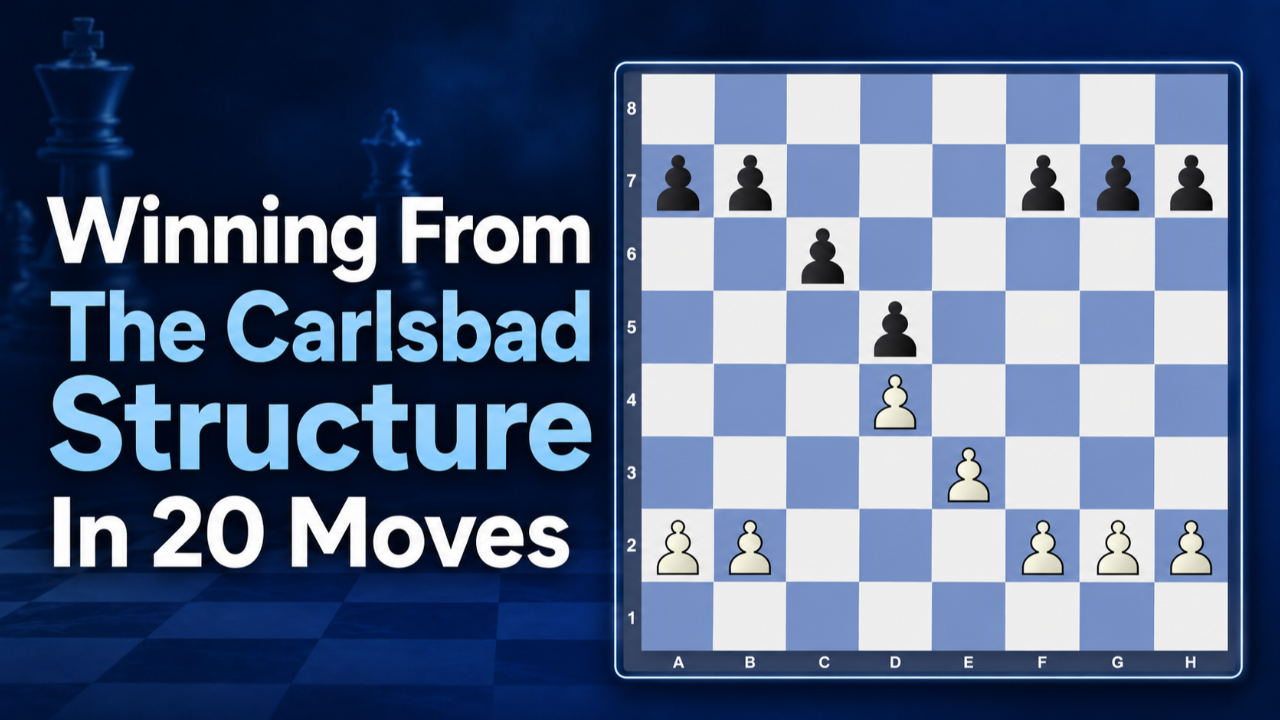
The Carlsbad pawn structure is one of the most common pawn structures in chess, and it looks like this: 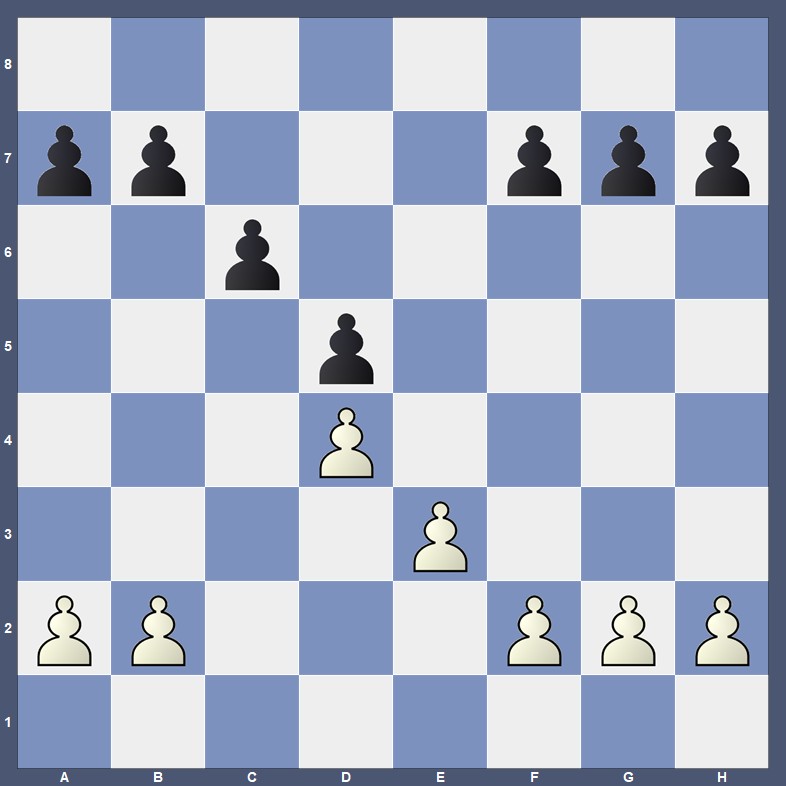
This structure arises from the Exchange Queen's Gambit Declined - with 1.d4 d5 2.c4 e6 3.Nc3 Nf6 4.cxd5 exd5 5.Bg5 being the most common example. (If you'd like to know a creative alternative to set Black fresh strategic problems, check out 'The Creative 1.d4 Repertoire'!)
But let's say that we 'flip' the structure around: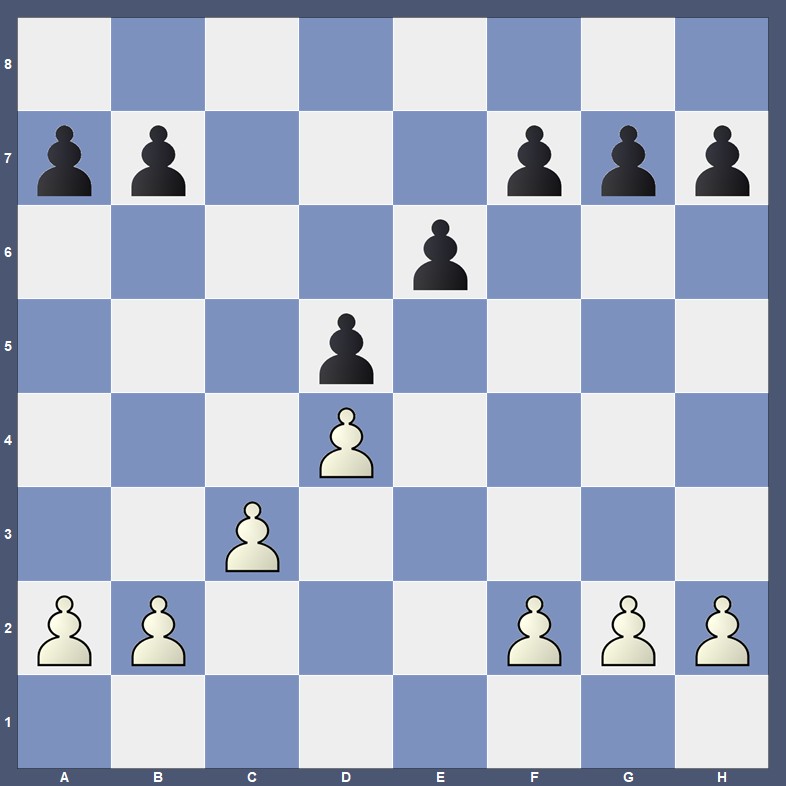
This structure arises from many more openings - like the d4 Sidelines (London, Colle, Torre) and the Exchange Caro-Kann. (I cover 1.e4 pawn structures in great detail here).
That's why it's important to know the Carlsbad structure well if you want to become a chess master - or just play either side of 1.d4 well in general.
In our illustrative game for this article, Gledura-Sadhwani, White wins in just 20 moves! And both players are rated over 2600 FIDE, and it was a 60+30 game to boot, making the miniature victory no small feat! But White was unable to play the 'usual' minority attack most players know about - so let's see how to play it when b4-b5 isn't so available or effective.
By the way, you can get your FREE 'Anti-Blunder Blueprint' by joining my free email list here.
The Opening
The game started 1.d4 d5 2.c4 e6 3.Nc3 a6!? - already a small surprise: 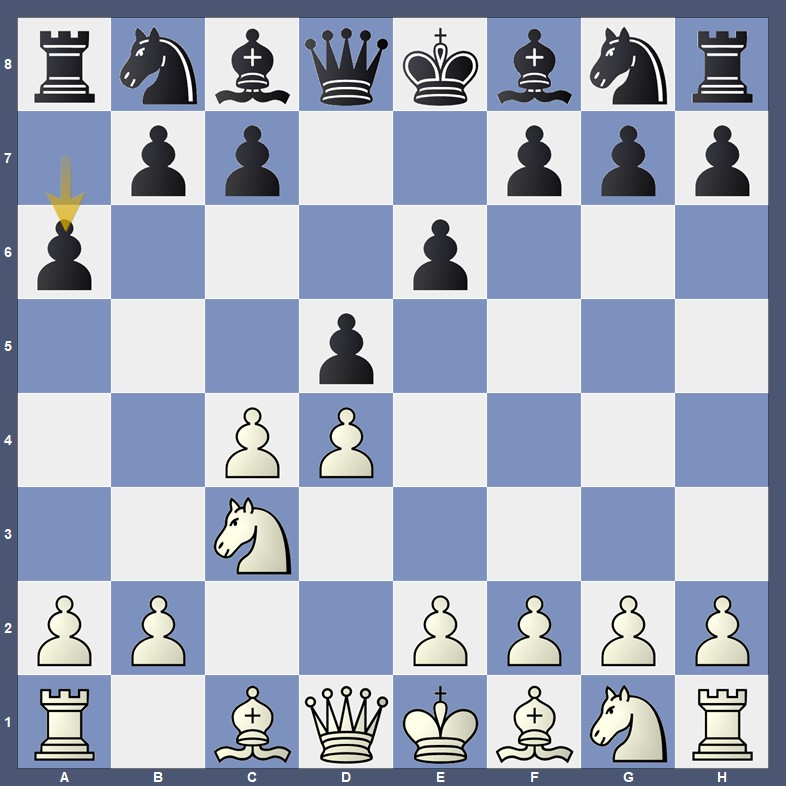
This is known as the 'Janowski QGD', after the old Polish chess master David Janowski. The idea is simple - Black wants to play ...dxc4 and hang on to the extra pawn with ...b5. If White wants to fight for an advantage, they are practically forced to play 4.cxd5 exd5 - again showing why it's critical to understand the Carlsbad structure to play 1.d4 successfully, as we can hardly avoid it.
After 5.Nf3, Black has a range of options - I usually played 5...Nf6 in my games, transposing to an old Carlsen favourite in 1.d4 Nf6 2.c4 e6 3.Nf3 d5 4.Nc3 a6!? 5.cxd5 exd5, while Carlsen himself has played the creative 5...h6!?, to avoid the Bg5 pin in the game, against other strong GMs like Ding Liren, Erigaisi and Karjakin.
But in the game, after 5...c6, Gledura went for a practical decision. Rather than trying to punish his opponent's surprise with some principled approach like 6.e4 dxe4 7.Ng5, Gledura took a practical approach with 6.Qb3!? Nf6 7.Bg5 Be7 8.e3 0-0 9.Bd3 Nbd7 10.0-0 Re8 11.Rac1, taking play back to a 'normal' Exchange QGD: 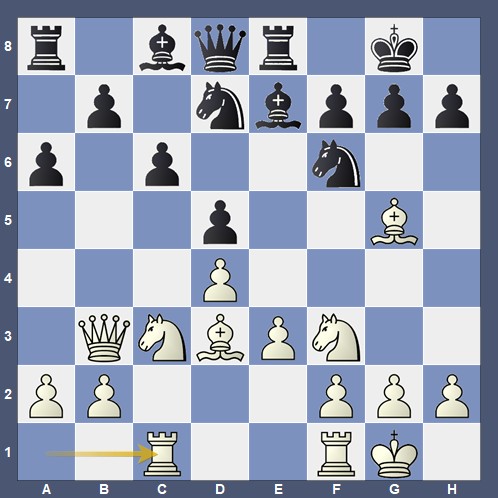
This is where understanding structures, not just memorizing theory, gives you the flexibility to adapt to the opponent's surprises. (And how often do our opponents actually 'follow' the theory we studied anyway?)
For what it's worth, 11.h3 or 11.Qc2 probably give White slightly better chances to take an opening advantage, but let's continue with the game - what would be your reply as White after 11.Rac1 Ne4? 
Rather than playing the automatic 12.Bxe7 Rxe7 13.Bxe4 dxe4 14.Nd2 Nf6 15.a3 Be6 16.Qc2 Bd5 17.h3 Qd7 with a reasonable game for Black - which is what the engine recommends - Gledura instead played 12.Bf4!? to keep more tension in the position - an idea favoured by Karpov in the 1980s and 90s after first playing h3. And it was clear that Sadhwani was not comfortable with this tension, because instead of keeping the tension with a solid move like 12...Ndf6, nurturing the standard e4 strongpoint, he changed the position with 12...Nxc3 13.bxc3 b5, only to find that the c4 break wasn't the only problem he had to deal with.
A tip I like to remember from Yermolinsky's 'The Road To Chess Improvement' book is - when the minority attack (b4-b5) or Pillsbury plan (Ne5/f4) aren't working, look to break in the centre with e4!
And that's what Gledura did, playing 14.e4! to leverage his lead in development and put Black under the pump in the centre: 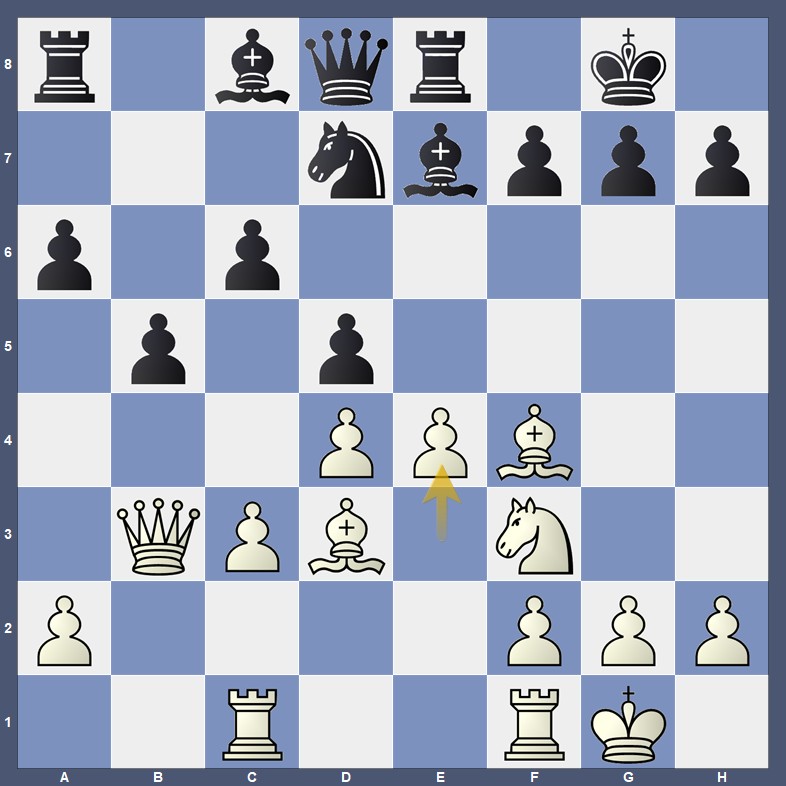
The Indian talent did not respond in the best way - instead of playing 14...Nb6 to take back on d5 with a piece, he opted for 14...Bb7? 15.exd5 cxd5, only to find that after 16.a4!, Black is unable to properly cover the b5-pawn, due to the undefended b7-bishop.
Remember GM John Nunn's old dictum from 'Secrets Of Practical Chess' - Loose Pieces Drop Off! (or LPDO for short).
After 16...Bc6 17.axb5 axb5, the Hungarian GM showed impressive restraint in resisting the obvious pawn grab of 18.Bxb5?!. The problem there is that after 18...Qb6! 19.Rb1 Ra3 20.Qb2 Bxb5 21.Qxb5 Qxb5 22.Rxb5 Nf6!, the extra pawn on c3 is quite weak, and thus not enough for White to have substantial winning chances. 
Therefore, Gledura flicked in an intermediate move: 18.Qb1!, threatening the h7-pawn first so that after 18...h6 19.Bxb5, the ...Qb6 trick would no longer work for Black, and White would remain a solid pawn up.
That's still preferable to the game continuation of 18...Nf6?! 19.Ne5! (taking advantage of the square just 'left behind' by their knight) 19...Qc7, which leads us to our final puzzle for the post!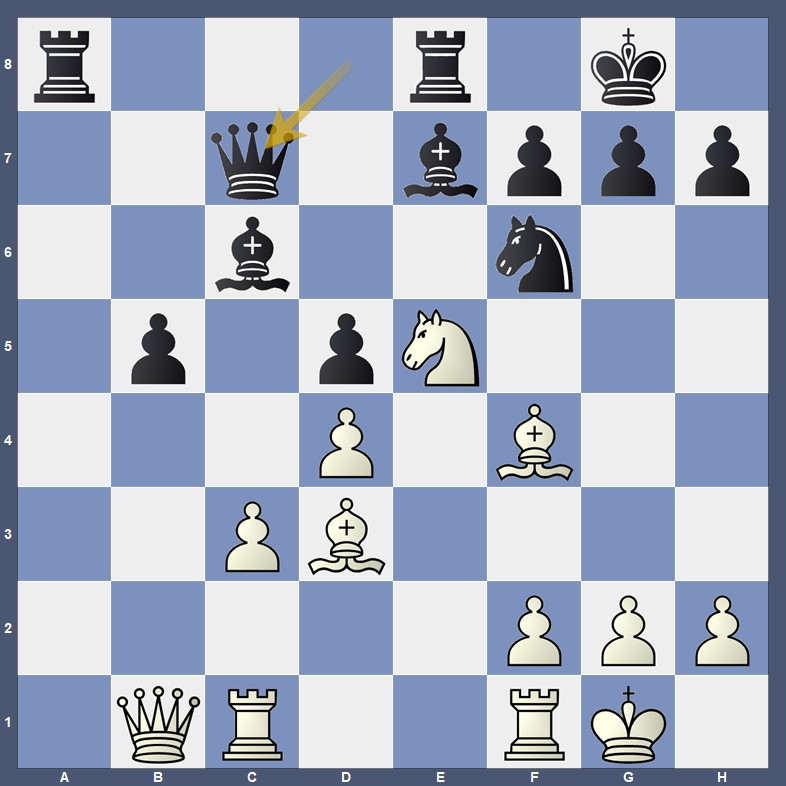
What would you play here as White? White's 20th move was so strong here that Black resigned in response!
________
So our answer is that Gledura played the DEADLY QUIET MOVE of 20.Bg3!, defending our prelate to threaten both Nxc6 followed by Bb5, skewering the queen and rook, and Nxf7. While Black's resignation may seem a bit early, the +2.77 evaluation by Stockfish 18 shows that the result is in no doubt between players of this calibre.
Summary/Conclusion
What were the main insights you took from this game?
Here's my summary of the Carlsbad structure for White:
- The standard plan is the minority attack with b4-b5, to isolate Black's pawn chain b7-c6-d5 into either several pawn islands or a backward c6-pawn. However, this isn't always possible.
- Our 'Plan B' is typically the Pillsbury plan with Ne5/f4, but once again, this tends to work only when conditions are right (e.g. Black played passively with moves like ...Be6 or ...g6).
- So if neither of our 'standard' plans are working, we should look to break in the centre, with e4.
- From Black's point of view, they should use ...Ne4 to exchange minor pieces to free their position, and also to prepare kingside counterplay with the pieces, using the e4-knight as a strongpoint (rather than trading it off as Sadhwani did in the game).
See you in the next post! If you enjoyed this one, subscribe to my free email list at https://www.simplechessimprovement.com/ for more just like it!
Get the unfair advantage over your next chess opponents!
Join our mailing list to receive daily chess improvement emails and free training videos from GM Max!
We hate SPAM. We will never sell your information, for any reason.