The Instant Benko Gambit
May 27, 2026
Did you know that you only need to remember one position to start playing the Benko Gambit as Black?
Here it is: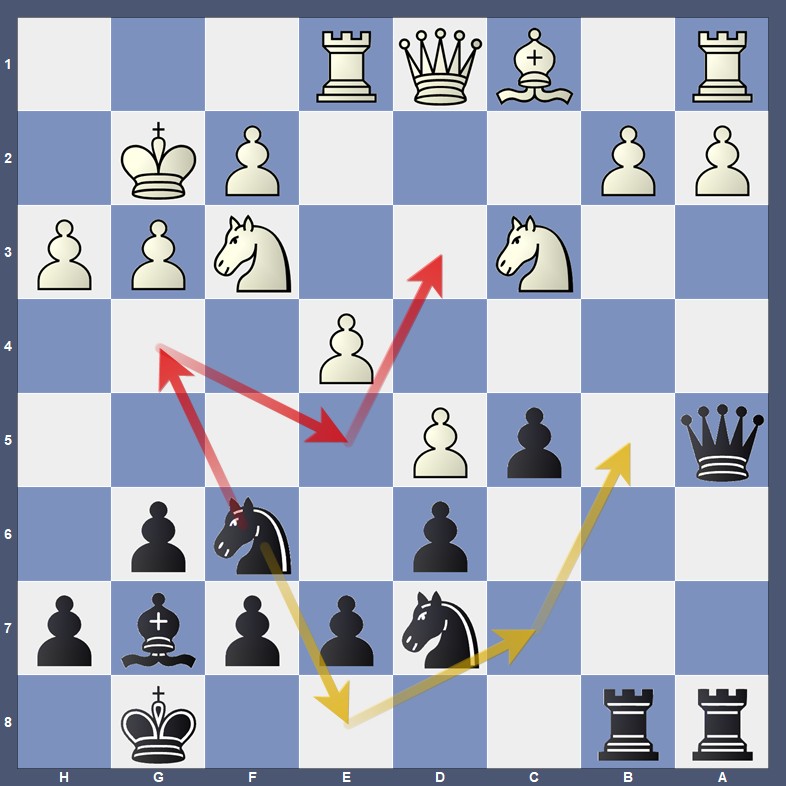
Where Our Pieces Belong In The Benko
This shows you where all of our pieces belong in the Benko Gambit:
- King's Bishop - fianchettoes to g7, where it has a wide open diagonal thanks to White's d4-d5;
- King - always castles short.
- Queen's Bishop - exchange it off via. a6
- Queen's Rook - stays on a8 as the a-file will open up anyway after cxb5 and bxa6. If they close the a-pawn, play ...Rb8.
- King's Rook - comes to b8 to pressure the exposed b2-pawn down the half-open file.
- Queen - typically comes to a5 to pressure the c3-knight. May also occasionally go to b6 instead, to pressure b2 more directly.
- Queen's Knight - sits perched on d7, where it can later go to e5 or a4/c4 via. b6 in the middlegame, depending on the position.
- King's Knight - develops at first to f6. But there it is in the way of the bishop, so you will often see manoeuvres like ...Ne8-c7-b5 (to eliminate the c3-knight and maximize the pressure on b2) or ...Ng4-e5, eyeing up the weak d3-square as a potentially beautiful outpost.
And they said the Benko Gambit wasn't a system opening?
How We Get There
The way we reached the diagram position was via. 1.d4 Nf6 2.c4 c5 3.d5 b5 4.cxb5 a6 5.bxa6 g6 6.Nc3 Bxa6 7.e4 Bxf1 8.Kxf1 d6 9.g3 Bg7 10.Kg2 0-0 11.Nf3 Nbd7 12.Re1 Qa5 13.h3 Rfb8.
These are the most common moves for White on each turn - you can expect to face 4.cxb5 a6 5.bxa6 at least as often as all the other lines after 3...b5 combined.
However, there are a few other things you should know about the Benko, if you want the very best results with this opening.
White Can Avoid The Benko
The Benko Gambit is not an all-in-one defence to 1.d4 - they can avoid 3.d5 or 2.c4.
While the alternatives to 3.d5 are not too scary - we can still go for a kingside fianchetto against 3.e3, and 3.Nf3 cxd4 4.Nxd4 e6 5.Nc3 d5 is a pretty clean equalizer in the worst-case scenario - 2.Nf3 is a major option, intending the London, Colle, Torre or Neo-Catalan.
But we can respond in the same way with 2...c5, intending to meet 3.d5 with 3...b5 for Benko-style play: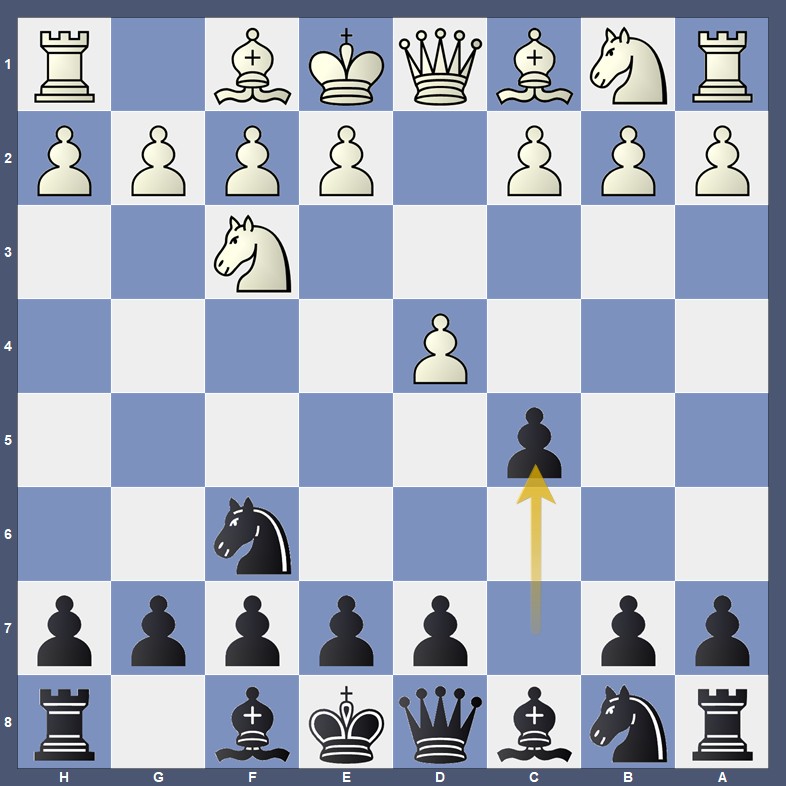
If White tries to play a London or Torre, they need to start with 3.c3. But then a tricky Nakamura favourite is 3...Qb6!?, preventing Bf4 or Bg5 and forcing White into a very different kind of position. We can still continue with ...g6/...Bg7/...0-0/...d6 from there to develop in a somewhat similar way to the Benko.
Likewise, after 3.e3, we can play 3...g6 4.Be2 Bg7 5.0-0 0-0 6.c4 cxd4 7.exd4 d5 8.Nc3 Nc6 to get nice active play, with a reversed Tarrasch QGD where the extra tempo is only enough for White to equalize.
And letting us get in ...cxd4 with 3.g3 cxd4 4.Bg2 e5 5.Nxe5? Qa5 or 3.Bf4? cxd4 4.Nxd4? e5! 5.Bxe5 Qa5, in both cases winning a piece with ...Qxe5 next move, is clearly not on for White.
The Problem Line
Unfortunately, the 'instant Benko Gambit' that I showed at the start of the post, playing it like a system opening, has a major problem.
After 1.d4 Nf6 2.c4 c5 3.d5 b5 4.cxb5 a6 5.bxa6 g6 6.Nc3 Bxa6 7.e4 Bxf1 8.Kxf1 d6 9.g3 Bg7 10.Kg2 0-0 11.Nf3 Nbd7, White's dream is to set up a blockade on the b5 and c4 squares, like this: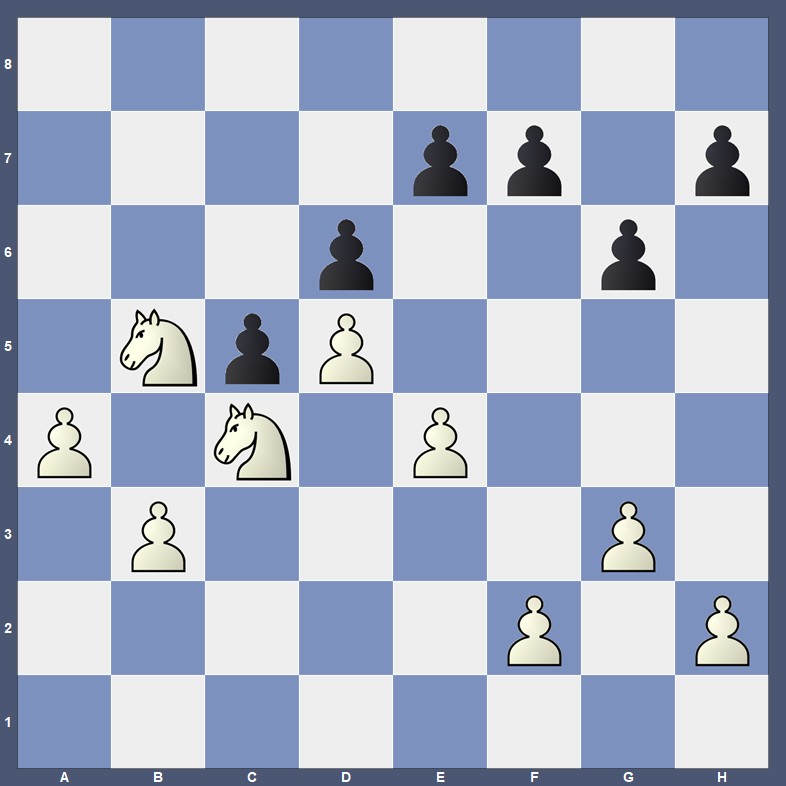
And if White is paying attention (or more likely, knows their engine theory), they can start to set this up with 12.a4!, obtaining a clear advantage with natural moves like Qe2, Ra3, Nb5 and Nd2-c4, sometimes with Bd2-c3 or b3 flicked in first to stabilize the position.
With Stockfish 18 giving a +0.77 evaluation for White at depth 38, we clearly need something better for prepared opposition.
Enter - The Modern Benko Gambit!
Fortunately for us, we have a better approach than ...g6/...Bxa6 that we saw at the start of this post.
We can play 5...e6!, in the spirit of the Blumenfeld Gambit (1.d4 Nf6 2.c4 e6 3.Nf3 c5 4.d5 b5):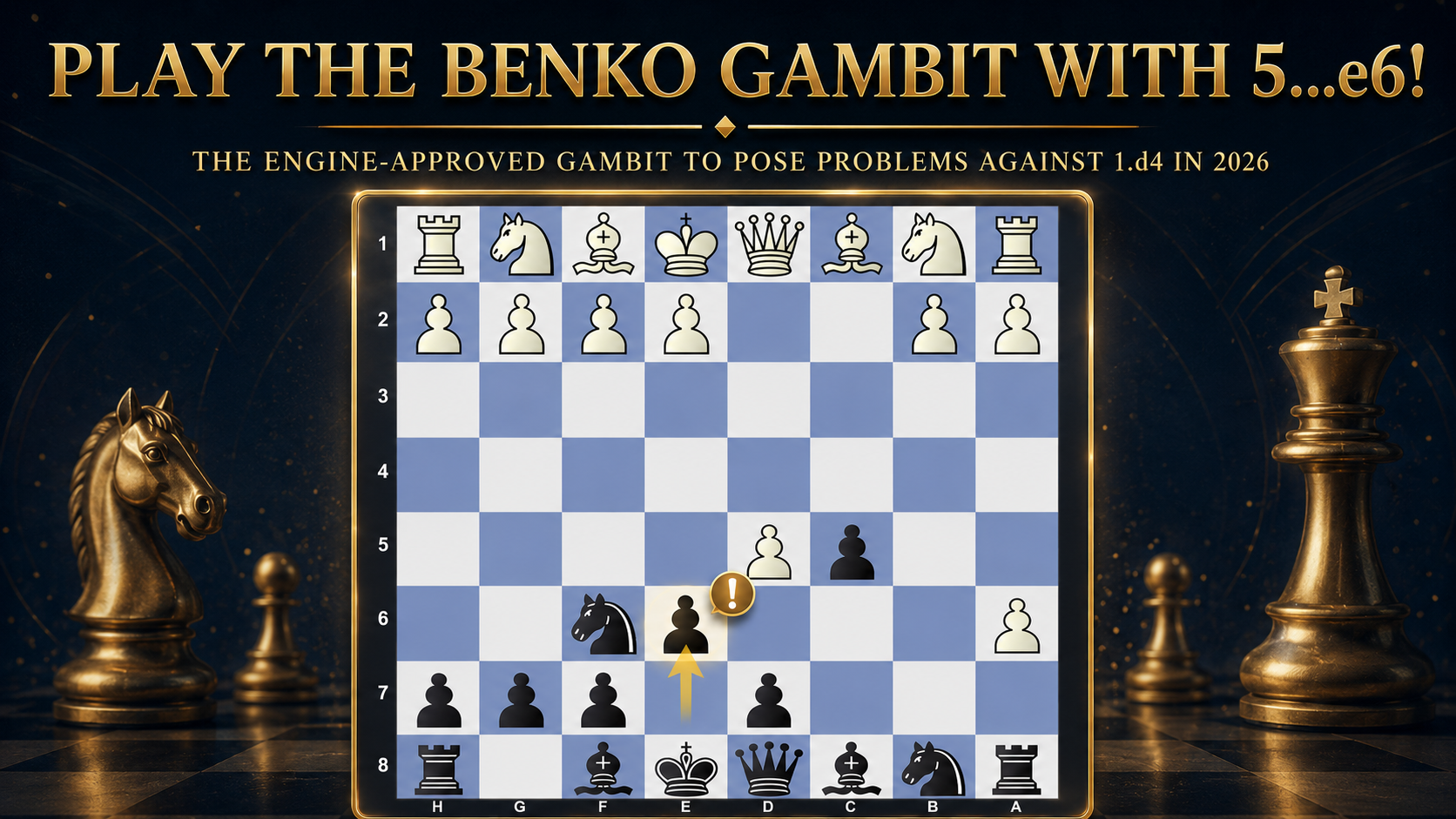
I analyzed this in a recent deep-dive 3 hour YouTube video, proving that Black obtains sufficient compensation in all lines after this move. In fact, the positions can even transpose directly to a good Blumenfeld Gambit for us after 6.dxe6 fxe6 7.Nf3, although you will face 6.Nc3 considerably more often in practice.
If you'd like to master these positions as Black, I recommend my PGN file 'Play The Benko Gambit With 5...e6!', which you can get for a small one-time fee here. It also includes 64 auto-annotated model games, which will show you how to play the middlegames and endgames well, so that you can turn those good positions from our preparation into wins in your games!
Good luck with playing the Benko Gambit in your games!
Get the unfair advantage over your next chess opponents!
Join our mailing list to receive daily chess improvement emails and free training videos from GM Max!
We hate SPAM. We will never sell your information, for any reason.